Mostrando entradas con la etiqueta Inglés. Mostrar todas las entradas

20/3/13

Edmund Husserl’s Letter to Lucien Lévy-Bruhl

Edmund Husserl’s Letter to Lucien Lévy-Bruhl - Full text


Husserl Levy Bruhl


Freiburg i. B.,March 11, 1935
Lorettostr. 40


Highly esteemed Colleague!


Is it not shameful that I am thanking you so tardily for the great, indeed very special pleasure you have given me by generously sending me your new work on the mythology of the primitives?Yet perhaps I can appease you by sharing with you the fact that it was the burning interest in your book that prevented me fromwriting. I let my own work sit; I took up the whole series of classic works on the mentality of the primitives you have bestowed on us; and that is what I have been immersed in for several weeks now. I can tell you that this is already the third letter I have drafted— hopefully this one will get finished. For I really wanted to tell you about the problematic that your foundational investigations have set in motion in me and in connection with my long-standing studies on humanity and the environing world [Umwelt]. Not for the first time now, but this time with particular intensity. My attempt to articulate it turned out badly, partly because it threatened to degenerate into a lengthy treatise and partly because, while trying to shorten it, I was distracted by external disturbances . . . (I mention only that I unfortunately have to write many letters to help, with foreign references, as best as I can those who have been legally affected so severely by the building anew the German nation— among them my own son, who, like yours, as a professor of jurisprudence, has the scientific vocation [Lebensberuf], or better, had, but now has to think of building a new future for himself abroad.)

It is beyond doubt that your works on the primitives must be regarded as classic foundational works of a thoroughly rigorous scientific ethnology. Over a large and particularly important domain, the possibility and absolute necessity | of a purely human-scientific [rein geisteswissenschaftliche] anthropology has become obvious— thus, as I could also say, of a pure psychology, which treats human beings not as objects belonging to nature [Naturobjekte], not psychophysically in the universe of spatio-temporal realities (in the objective spatio-temporality of concern to the natural sciences), but rather viewsas persons, as conscious subjects [Bewusstseinssubjekte], as they concretely find themselves and refer to themselves with personal pronouns. Saying “I” and “we,” they find themselves as members of families, associations, social units [Sozialitäten], as living “together,” exerting an influence on and suffering from their world—the world that has sense and reality for them, through their intentional life, their experiencing, thinking, valuing. Naturally, we have long known that every human being has a “world-representation,” that every nation, every supranational [übernationale] cultural grouping lives, so to speak, in a distinct world as its own environing world [in einer anderen Welt als seinerUmwelt lebt], and so again every historical time in its.Yet, in contrast to this empty generalization, your work and your exceptional theme has made us sensitive to something overwhelmingly new: namely, that it is a possible and highly important and great task to “empathize” with a humanity living self-contained in living generative sociality [lebendiger generativer Sozialität] and to understand this humanity as having, in and through its socially unified life, the world, which for it is not a “world-representation” but rather the world that actually exists for it [die für siewirklich seiendeWelt].Thereby we learn to understand its ways of apperceiving, identifying, thinking, thus its logic and its ontology, that of its environing world with the respective categories. The primitives’ “lack of history” keeps us from foundering in a sea of historical cultural traditions, documents, wars, politics, and so on, and, consequently, from overlooking the concrete correlation between pure spiritual life and the environing world as its validity-formation [Geltungsgebilde], and thus also from not making it a central scientific theme. It is obvious that the same task has to emerge now for all humanities accessible to us that are living in self-contained seclusion [in Abgeschlossenheit]—and indeed now also for those humanities whose self-enclosed community life [deren abgeschlossenes Gemeinschaftsleben] consists not in stagnation due to a lack of history (as a life that is nothing but flowing present) but in a truly historical life, which as such a nationalhas future and incessantly wants future. Accordingly, such a sociality does not have, so to speak, a static environing world | but a world that has partly a realized future (national “past”) and partly a future that has still to be realized, as that which has to be formed according to national goals. This thus leads us to the general problematic of history—to the psychology of the historical spirit [geschichtlicherGeist] in all its possible forms and relativities ( nation and inner construction of the nation out of particular social communities; on the other hand, the type of supranation [Übernation] as a sociality [Gesellschaftlichkeit] of nations, etc.). For a historical community, we would thus have the problem, as in the case of the primitives, as a correlative problem [als Korrelativproblem]: the unity of a cohesive national life and in it theworld—which for the nation is full of life, concrete, and real—with its set of structural types [Strukturtypik]. Likewise, a connection [Konnex] of nations and the higher unity “supranation” (Europe or, e.g.,China), as well as, so to speak, the logic, the ontology of the respective humanities and environing worlds. Initially, these tasks are historically concrete regarding the factually known nations and supranations, but then they are also universal psychological tasks—in the sense of a pure inner psychology [Innenpsychologie] of concretions, for which a methodology still has to be devised. However, I see a first beginning that has been opened up by your foundational works. 

For me, in the present state of the life’s work I have incessantly carried out, this perspective is of the highest interest, because many years ago I put to myself the problem of the correlation [dasKorrelationsproblem] between We and environingworld as a “transcendental-phenomenological” problem with regard to the possible manifold “we,” and in fact ultimately refers back to the problem of the absolute ego.* For it is in its horizon of consciousness that all social units and the environing worlds relative to them have constructed sense and validity [Sinn und Geltung] and, in changing, continue to build them always anew. I feel certain that on this path of an intentional analysis, which I have already worked out extensively, historical relativism proves to be undoubtedly justified (as an anthropological fact), but also that anthropology, like every positive science and its universality [Universitas], though the first, is not the final word of knowledge—scientific knowledge. Positive science is consistently [konsequent] objective science; it is science within the taken-for-grantedness [Selbstverständlichkeit] of the being of the objective world and of human being as real factual existence [realenDasein] in theworld. Transcendental phenomenology is the radical and consistent | science of subjectivity, which ultimately constitutes the world in itself. In other words, it is the science that reveals the universal taken-for-grantedness “world and we human beings in the world” to be an obscurity [Unverständlichkeit], thus an enigma, a problem, and that makes it scientifically intelligible [verständlich] in the solely possibleway of radical self-examination. It is a scientificity that is novel by virtue of this radicality; it proceeds as a systematic analysis, which systematically shows theABCs and the elementary grammar of the formation [Bildung] of “objects” as unities of validity [Geltungseinheiten], of object-manifolds and infinities as valid [geltende] “worlds” for sense bestowing subjects, and thereby, as a philosophy, it ascends from below into the heights.

 Perhaps the new publications I have prepared (which I still hope to bring out, despite the political upheavals that encroach all too much on my personal existence) will give some idea of how promising and concrete the method is by which I intend to found, contrary to feeble mysticism and irrationalism, a kind of super-rationalism[ Überrationalismus], which supersedes the old rationalism due to its inadequacy while nonetheless justifying its innermost intentions.

 Have I taxed your patience for too long? Well, perhaps I have at least given you a general idea—which should please you—of the kind of strong impetuses that can still come from your life’s work, far beyond the ethnological impacts of many years standing that have brought you so much admiration. I just think that this is still not enough. There are important principles in your works that will find their entelechies in the future. May you to retain, for many years to come, your marvelous mental powers, so that, even at a grand old age, you will be able to produce more foundational works.

19/3/13

Hegel, Schelling, Hölderlin - The Oldest Systematic Program of German Idealism


The Oldest Systematic Program of German Idealism

Full text


Hegel, Schelling, Hölderlin
Idealismo Alemán


An Ethics. Since all metaphysics will henceforth fall into morals-- for which Kant, with both of his practical postulates has given only an example and exhausted nothing, so this ethics will contain nothing other than a complete system of all ideas, or what is the same, of all practical postulates. The first idea is naturally the conception of my selfas an absolutely free being. Along with the free, self-conscious being an entire world emerges simultaneously-- out of nothingness-- the only true and conceivable creation out of nothingness-- Here I will descend to the fields of physics; the question is this: How should a world be constituted for a moral being? I should like to give our physics, progressing laboriously with experiments, wings again. 

So whenever philosophy provides the ideas, experience the data, we can finally obtain physics on the whole, which I expect of later epochs. It does not seem as if present day physics could satisfy a creative spirit such as ours is or should be.

From nature I come to man's works. The idea of the human race first-- I want to show that there is no idea of the state because the state is something mechanical, just as little as there is an idea of a machine. Only that which is the object of freedom is called idea. We must therefore go beyond the state!-- Because every state must treat free human beings like mechanical works; and it should not do that; therefore it should cease. You see for yourself that here all the ideas, that of eternal peace, etc., are merely subordinate ideas of a higher idea. At the same time I want to set forth the principles for a history a human race here and expose the whole miserable human work of state, constitution, government, legislature-- down to the skin. Finally the ideas of a moral world, deity, immortality-- overthrow of everything ((superstition)) pseudo doctrines, persecution of the priesthood, which recently poses as reason, come through itself. --(The) absolute freedom of all spirits who carry the intellectual world within themselves, and may not seek either God or immortality outside of themselves.


Finally the idea which unites all, the idea of beauty, the word taken in the higher taken in the higher platonic sense. I am convinced that the highest act of reason, which, in that it comprises all ideas, is an aesthetic act, and that truth and goodness are united like sisters only in beauty-- The philosopher must possess just as much aesthetic power as the poet. The people without aesthetic sense are our philosophers of the letter. The philosophy of the spirit is an aesthetic philosophy. One cannot be clever in anything, one cannot even reason cleverly in history-- without aesthetic sense. It should now be revealed here what those people who do not understand ideas are actually lacking-- and candidly enough admit that everything is obscure to them as soon as one goes beyond charts and indices. 
Poetry thereby obtains a higher dignity; it becomes again in the end what it was in the beginning-- teacher of (history) the human race because there is no longer any philosophy, any history; poetic art alone will outlive all the rest of the sciences and arts. 


At the same time we so often hear that the great multitude should have a sensual religion. Not only the great multitude, but even philosophy needs it. Monotheism of reason and the heart, polytheism of the imagination and art, that is what we need!


First I will speak about an idea here, which as far as I know, has never occurred to anyone's mind-- we must have a new mythology; this mythology must, however, stand in the service of ideas, it must become a mythology of reason.


Until we make ideas aesthetic, i.e., mythological, they hold no interest for the people, and conversely, before mythology is reasonable, the philosopher must be ashamed of it. Thus finally the enlightened and unenlightened must shake hands; mythology must become philosophical, and the people reasonable, and philosophy must become mythological in order to make philosophy sensual. Then external unity will reign among us. Never again the contemptuous glance, never the blind trembling of the people before its wise men and priests. Only then does equal development of all powers await us, of the individual as well as if all individuals. No power will be suppressed any longer, then general freedom and equality of spirits will reign-- A higher spirit sent from heaven must establish this religion among us, it will be the last work of the human race.

18/3/13

Kant - What is enlightenment - Full text


What Is Enlightenment? 
Immanuel Kant - Full Text
 

Emanuel Kant


Enlightenment is man's emergence from his self-imposed nonage. Nonage is the inability to use one's own understanding without another's guidance. This nonage is self-imposed if its cause lies not in lack of understanding but in indecision and lack of courage to use one's own mind without another's guidance. Dare to know! (Sapere aude.) "Have the courage to use your own understanding," is therefore the motto of the enlightenment.

Laziness and cowardice are the reasons why such a large part of mankind gladly remain minors all their lives, long after nature has freed them from external guidance. They are the reasons why it is so easy for others to set themselves up as guardians. It is so comfortable to be a minor. If I have a book that thinks for me, a pastor who acts as my conscience, a physician who prescribes my diet, and so on--then I have no need to exert myself. I have no need to think, if only I can pay; others will take care of that disagreeable business for me. Those guardians who have kindly taken supervision upon themselves see to it that the overwhelming majority of mankind--among them the entire fair sex--should consider the step to maturity, not only as hard, but as extremely dangerous. First, these guardians make their domestic cattle stupid and carefully prevent the docile creatures from taking a single step without the leading-strings to which they have fastened them. Then they show them the danger that would threaten them if they should try to walk by themselves. Now this danger is really not very great; after stumbling a few times they would, at last, learn to walk. However, examples of such failures intimidate and generally discourage all further attempts.

Thus it is very difficult for the individual to work himself out of the nonage which has become almost second nature to him. He has even grown to like it, and is at first really incapable of using his own understanding because he has never been permitted to try it. Dogmas and formulas, these mechanical tools designed for reasonable use--or rather abuse--of his natural gifts, are the fetters of an everlasting nonage. The man who casts them off would make an uncertain leap over the narrowest ditch, because he is not used to such free movement. That is why there are only a few men who walk firmly, and who have emerged from nonage by cultivating their own minds.

It is more nearly possible, however, for the public to enlighten itself; indeed, if it is only given freedom, enlightenment is almost inevitable. There will always be a few independent thinkers, even among the self-appointed guardians of the multitude. Once such men have thrown off the yoke of nonage, they will spread about them the spirit of a reasonable appreciation of man's value and of his duty to think for himself. It is especially to be noted that the public which was earlier brought under the yoke by these men afterwards forces these very guardians to remain in submission, if it is so incited by some of its guardians who are themselves incapable of any enlightenment. That shows how pernicious it is to implant prejudices: they will eventually revenge themselves upon their authors or their authors' descendants. Therefore, a public can achieve enlightenment only slowly. A revolution may bring about the end of a personal despotism or of avaricious tyrannical oppression, but never a true reform of modes of thought. New prejudices will serve, in place of the old, as guide lines for the unthinking multitude.

This enlightenment requires nothing but freedom--and the most innocent of all that may be called "freedom": freedom to make public use of one's reason in all matters. Now I hear the cry from all sides: "Do not argue!" The officer says: "Do not argue--drill!" The tax collector: "Do not argue--pay!" The pastor: "Do not argue--believe!" Only one ruler in the world says: "Argue as much as you please, but obey!" We find restrictions on freedom everywhere. But which restriction is harmful to enlightenment? Which restriction is innocent, and which advances enlightenment? I reply: the public use of one's reason must be free at all times, and this alone can bring enlightenment to mankind.

On the other hand, the private use of reason may frequently be narrowly restricted without especially hindering the progress of enlightenment. By "public use of one's reason" I mean that use which a man, as scholar, makes of it before the reading public. I call "private use" that use which a man makes of his reason in a civic post that has been entrusted to him. In some affairs affecting the interest of the community a certain [governmental] mechanism is necessary in which some members of the community remain passive. This creates an artificial unanimity which will serve the fulfillment of public objectives, or at least keep these objectives from being destroyed. Here arguing is not permitted: one must obey. Insofar as a part of this machine considers himself at the same time a member of a universal community--a world society of citizens--(let us say that he thinks of himself as a scholar rationally addressing his public through his writings) he may indeed argue, and the affairs with which he is associated in part as a passive member will not suffer. Thus it would be very unfortunate if an officer on duty and under orders from his superiors should want to criticize the appropriateness or utility of his orders. He must obey. But as a scholar he could not rightfully be prevented from taking notice of the mistakes in the military service and from submitting his views to his public for its judgment. The citizen cannot refuse to pay the taxes levied upon him; indeed, impertinent censure of such taxes could be punished as a scandal that might cause general disobedience. Nevertheless, this man does not violate the duties of a citizen if, as a scholar, he publicly expresses his objections to the impropriety or possible injustice of such levies. A pastor, too, is bound to preach to his congregation in accord with the doctrines of the church which he serves, for he was ordained on that condition. But as a scholar he has full freedom, indeed the obligation, to communicate to his public all his carefully examined and constructive thoughts concerning errors in that doctrine and his proposals concerning improvement of religious dogma and church institutions. This is nothing that could burden his conscience. For what he teaches in pursuance of his office as representative of the church, he represents as something which he is not free to teach as he sees it. He speaks as one who is employed to speak in the name and under the orders of another. He will say: "Our church teaches this or that; these are the proofs which it employs." Thus he will benefit his congregation as much as possible by presenting doctrines to which he may not subscribe with full conviction. He can commit himself to teach them because it is not completely impossible that they may contain hidden truth. In any event, he has found nothing in the doctrines that contradicts the heart of religion. For if he believed that such contradictions existed he would not be able to administer his office with a clear conscience. He would have to resign it. Therefore the use which a scholar makes of his reason before the congregation that employs him is only a private use, for no matter how sizable, this is only a domestic audience. In view of this he, as preacher, is not free and ought not to be free, since he is carrying out the orders of others. On the other hand, as the scholar who speaks to his own public (the world) through his writings, the minister in the public use of his reason enjoys unlimited freedom to use his own reason and to speak for himself. That the spiritual guardians of the people should themselves be treated as minors is an absurdity which would result in perpetuating absurdities.

But should a society of ministers, say a Church Council, . . . have the right to commit itself by oath to a certain unalterable doctrine, in order to secure perpetual guardianship over all its members and through them over the people? I say that this is quite impossible. Such a contract, concluded to keep all further enlightenment from humanity, is simply null and void even if it should be confirmed by the sovereign power, by parliaments, and the most solemn treaties. An epoch cannot conclude a pact that will commit succeeding ages, prevent them from increasing their significant insights, purging themselves of errors, and generally progressing in enlightenment. That would be a crime against human nature whose proper destiny lies precisely in such progress. Therefore, succeeding ages are fully entitled to repudiate such decisions as unauthorized and outrageous. The touchstone of all those decisions that may be made into law for a people lies in this question: Could a people impose such a law upon itself? Now it might be possible to introduce a certain order for a definite short period of time in expectation of better order. But, while this provisional order continues, each citizen (above all, each pastor acting as a scholar) should be left free to publish his criticisms of the faults of existing institutions. This should continue until public understanding of these matters has gone so far that, by uniting the voices of many (although not necessarily all) scholars, reform proposals could be brought before the sovereign to protect those congregations which had decided according to their best lights upon an altered religious order, without, however, hindering those who want to remain true to the old institutions. But to agree to a perpetual religious constitution which is not publicly questioned by anyone would be, as it were, to annihilate a period of time in the progress of man's improvement. This must be absolutely forbidden.

A man may postpone his own enlightenment, but only for a limited period of time. And to give up enlightenment altogether, either for oneself or one's descendants, is to violate and to trample upon the sacred rights of man. What a people may not decide for itself may even less be decided for it by a monarch, for his reputation as a ruler consists precisely in the way in which he unites the will of the whole people within his own. If he only sees to it that all true or supposed [religious] improvement remains in step with the civic order, he can for the rest leave his subjects alone to do what they find necessary for the salvation of their souls. Salvation is none of his business; it is his business to prevent one man from forcibly keeping another from determining and promoting his salvation to the best of his ability. Indeed, it would be prejudicial to his majesty if he meddled in these matters and supervised the writings in which his subjects seek to bring their [religious] views into the open, even when he does this from his own highest insight, because then he exposes himself to the reproach: Caesar non est supra grammaticos.   It is worse when he debases his sovereign power so far as to support the spiritual despotism of a few tyrants in his state over the rest of his subjects.

When we ask, Are we now living in an enlightened age? the answer is, No, but we live in an age of enlightenment. As matters now stand it is still far from true that men are already capable of using their own reason in religious matters confidently and correctly without external guidance. Still, we have some obvious indications that the field of working toward the goal [of religious truth] is now opened. What is more, the hindrances against general enlightenment or the emergence from self-imposed nonage are gradually diminishing. In this respect this is the age of the enlightenment and the century of Frederick [the Great].

A prince ought not to deem it beneath his dignity to state that he considers it his duty not to dictate anything to his subjects in religious matters, but to leave them complete freedom. If he repudiates the arrogant word "tolerant", he is himself enlightened; he deserves to be praised by a grateful world and posterity as that man who was the first to liberate mankind from dependence, at least on the government, and let everybody use his own reason in matters of conscience. Under his reign, honorable pastors, acting as scholars and regardless of the duties of their office, can freely and openly publish their ideas to the world for inspection, although they deviate here and there from accepted doctrine. This is even more true of every person not restrained by any oath of office. This spirit of freedom is spreading beyond the boundaries [of Prussia] even where it has to struggle against the external hindrances established by a government that fails to grasp its true interest. [Frederick's Prussia] is a shining example that freedom need not cause the least worry concerning public order or the unity of the community. When one does not deliberately attempt to keep men in barbarism, they will gradually work out of that condition by themselves.

I have emphasized the main point of the enlightenment--man's emergence from his self-imposed nonage--primarily in religious matters, because our rulers have no interest in playing the guardian to their subjects in the arts and sciences. Above all, nonage in religion is not only the most harmful but the most dishonorable. But the disposition of a sovereign ruler who favors freedom in the arts and sciences goes even further: he knows that there is no danger in permitting his subjects to make public use of their reason and to publish their ideas concerning a better constitution, as well as candid criticism of existing basic laws. We already have a striking example [of such freedom], and no monarch can match the one whom we venerate.

But only the man who is himself enlightened, who is not afraid of shadows, and who commands at the same time a well disciplined and numerous army as guarantor of public peace--only he can say what [the sovereign of] a free state cannot dare to say: "Argue as much as you like, and about what you like, but obey!" Thus we observe here as elsewhere in human affairs, in which almost everything is paradoxical, a surprising and unexpected course of events: a large degree of civic freedom appears to be of advantage to the intellectual freedom of the people, yet at the same time it establishes insurmountable barriers. A lesser degree of civic freedom, however, creates room to let that free spirit expand to the limits of its capacity. Nature, then, has carefully cultivated the seed within the hard core--namely the urge for and the vocation of free thought. And this free thought gradually reacts back on the modes of thought of the people, and men become more and more capable of acting in freedom. At last free thought acts even on the fundamentals of government and the state finds it agreeable to treat man, who is now more than a machine, in accord with his dignity.

5/3/13

Yeats - Poems


William Butler Yeats

William Butler Yeats (Dublín, 
13 de junio de 1865 - Roquebrune-
Cap-Martin, Francia, 28 de enero 
de 1939), irish poet and playwright.


THE STOLEN CHILD


Where dips the rocky highland
Of Sleuth Wood in the lake,
There lies a leafy island
Where flapping herons wake
The drowsy water-rats:
There we've hid our faery vats,
Full of berries
And of reddest stolen cherries.
Come away, O human child! 
To the waters and the wild 
With a faery, hand in hand, 
For the world's more full of weeping than you can understand.

Where the wave of moonlight glosses
The dim grey sands with light,
Far off by furthest Rosses
We foot it all the night,
Weaving olden dances,
Mingling hands and mingling glances
Till the moon has taken flight;
To and fro we leap
And chase the frothy bubbles,
While the world is full of troubles
And is anxious in its sleep.
Come away, O human child! 
To the waters and the wild 
With a faery, hand in hand, 
For the world's more full of weeping than you can understand.

Where the wandering water gushes
From the hills above Glen-Car,
In pools among the rushes
That scarce could bathe a star,
We seek for slumbering trout
And whispering in their ears
Give them unquiet dreams;
Leaning softly out
From ferns that drop their tears
Over the young streams.
Come away, O human child! 
To the waters and the wild 
With a faery, hand in hand, 
For the world's more full of weeping than you can understand.

Away with us he's going,
The solemn-eyed:
He'll hear no more the lowing
Of the calves on the warm hillside
Or the kettle on the hob
Sing peace into his breast,
Or see the brown mice bob
Round and round the oatmeal-chest.
For he comes, the human child, 
To the waters and the wild 
With a faery, hand in hand, 
From a world more full of weeping than he can understand.


2/3/13

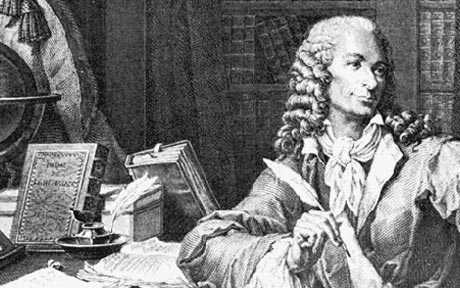
Voltaire [English]

François Marie Arouet [Voltaire] (París,
november 21 1694 – ibídem, may 30 1778)


In the middle of the institutional crisis of the catholic church, Voltaire offers us an intresting perspective of the catholic extremism.

CHAPTER VI:

"After the earthquake, which had destroyed three-fourths of the city of Lisbon, the sages of that
country could think of no means more effectual to preserve the kingdom from utter ruin than to entertain the people with an auto-da-fé12, it having been decided by the University of Coimbra, that the burning of a few people alive by a slow fire, and with great ceremony, is an infallible preventive of earthquakes.